Robot Stranger Danger: What to Tell Your Kids About AI Chatbots
By Gena Peth, Screen Smart Moms
Robot Stranger Danger: What to Tell Your Kids About AI Chatbots
Your child's newest "friend" may never get tired, never disagree, and never go to sleep. That is exactly the problem.
A new CBN News report says parents need to add a new kind of "stranger danger" talk: warning kids about getting attached to lifelike AI personas. I read the full story. Here is what it says, what has changed since, and what you can do this week.
What the report says:
The story looks back at testimony from parents before a Senate committee last year.
Matthew Raine told senators that his 16-year-old son Adam started using ChatGPT for homework. Over time it became a confidant, and Matthew called it a "suicide coach." After Adam died, he read six months of chats and found the chatbot had brought up suicide more than a thousand times.
Megan Garcia said her 14-year-old son, Sewell Setzer, died after a chatbot that acted like his girlfriend pulled him deeper into a relationship with it.
An anonymous mother said chatbots pushed her son away from her family's faith and hurt his mental health.
Melissa Henson of Concerned Women for America warned that chatbots can also hold sexual conversations with minors.
The advice from experts is practical. Keep devices out of bedrooms. Let kids use AI only in shared spaces where you can walk by and look at the screen. Add filters, time limits, and monitoring. Most of all, keep talking. Donna Rice Hughes of Enough Is Enough reminded parents that predators use games and social platforms, and chatbots are the same kind of risk.
Why this is different from other apps:
A chatbot is not a search engine. It is built to keep a conversation going.
Many are trained on feedback that rewards answers that feel warm and validating. Many remember what your child tells them. Researchers call the result sycophancy, which means the AI agrees with almost everything and rarely pushes back.
For a lonely or struggling teen, that feels like friendship. But no one on the other end is concerned about them.
This is not rare. A 2025 Common Sense Media survey found that 72% of teens have tried an AI companion, and 52% use one regularly. About a third of those teens said they had chosen an AI over a real person to talk about something serious.
The new stranger danger talk:
Several things come together here.
We taught our kids not to talk to strangers. Now we also need to teach them that some strangers are not people.
Here are three lines to say out loud, in your own words:
"AI can sound like a friend, but it can't care about you."
"What you type may be saved, so don't treat it like a diary."
"If an AI ever talks about hurting yourself, asks you to keep a secret, or says your family doesn't understand you, show me right away. You will not be in trouble."
That last line matters most. A child who knows they will not be punished for telling you is much safer than a child who is hiding.
What to do this week
Move AI into shared spaces. Keep devices out of bedrooms overnight.
Open the app your child uses most and look for a chat or companion feature. Start with the app you assume is fine, not the one you already worry about.
Turn on the controls that exist. ChatGPT has parental controls you can link to your teen's account, Snapchat has Family Center for its My AI feature, and Meta has announced controls for AI characters on Instagram. These help, but they cannot see everything, and teens can work around them.
Ask one open question tonight: "Have you ever talked to an AI the way you'd talk to a friend?" Then listen without reacting.
Know the red flags. These include secrecy about an app, preferring AI to real friends, distress when access is removed, and AI use that spikes late at night or after a hard day.

Is anything being done?
The report says Congress has not passed protections. Here is where things stand now.
In August 2026, a Senate committee advanced two bills, the CHATBOT Act and the Youth AI Privacy Act. Neither is law yet.
New York and California already have laws on AI companion chatbots.
State attorneys general in Kentucky and Florida have sued AI chatbot companies over harm to children, and Pennsylvania has sued over chatbots posing as licensed professionals.
Some companies have added age estimates and parental controls, though they are imperfect.
Policy takes years. Your child is online tonight. That is why what happens in your home matters most.
How the Screen Smart Moms CPR Framework supports you
Connect:
Stay the safest place for your child to talk. If you are not, AI often will be.Protect:
Use shared spaces, parental controls, and regular app checks. Recheck after updates.Regulate:
Teach your child that AI is a tool for tasks, not feelings. Build the habit of checking what it says and turning to a real person first.
A Final Word to Moms
If this was hard to read, you are not alone. These stories are heartbreaking, and the point of sharing them is not fear. It is preparation.
You do not have to become a tech expert. You do have to stay close. A child who feels safe telling you the strange thing a chatbot said is protected in a way no setting can match.
Key Takeaways for Moms
AI chatbots are built to keep kids talking and to agree with them, which can create a false sense of friendship.
Teach a new stranger danger rule: some strangers are not people, and your child should tell you if an AI asks for secrets or talks about self-harm.
Shared spaces, controls, and open conversations work together. No single tool is enough.
If you or your child is having thoughts of suicide, call or text 988 (the Suicide & Crisis Lifeline) right away. If a child is in immediate danger, call 911.
Get the free guides today!
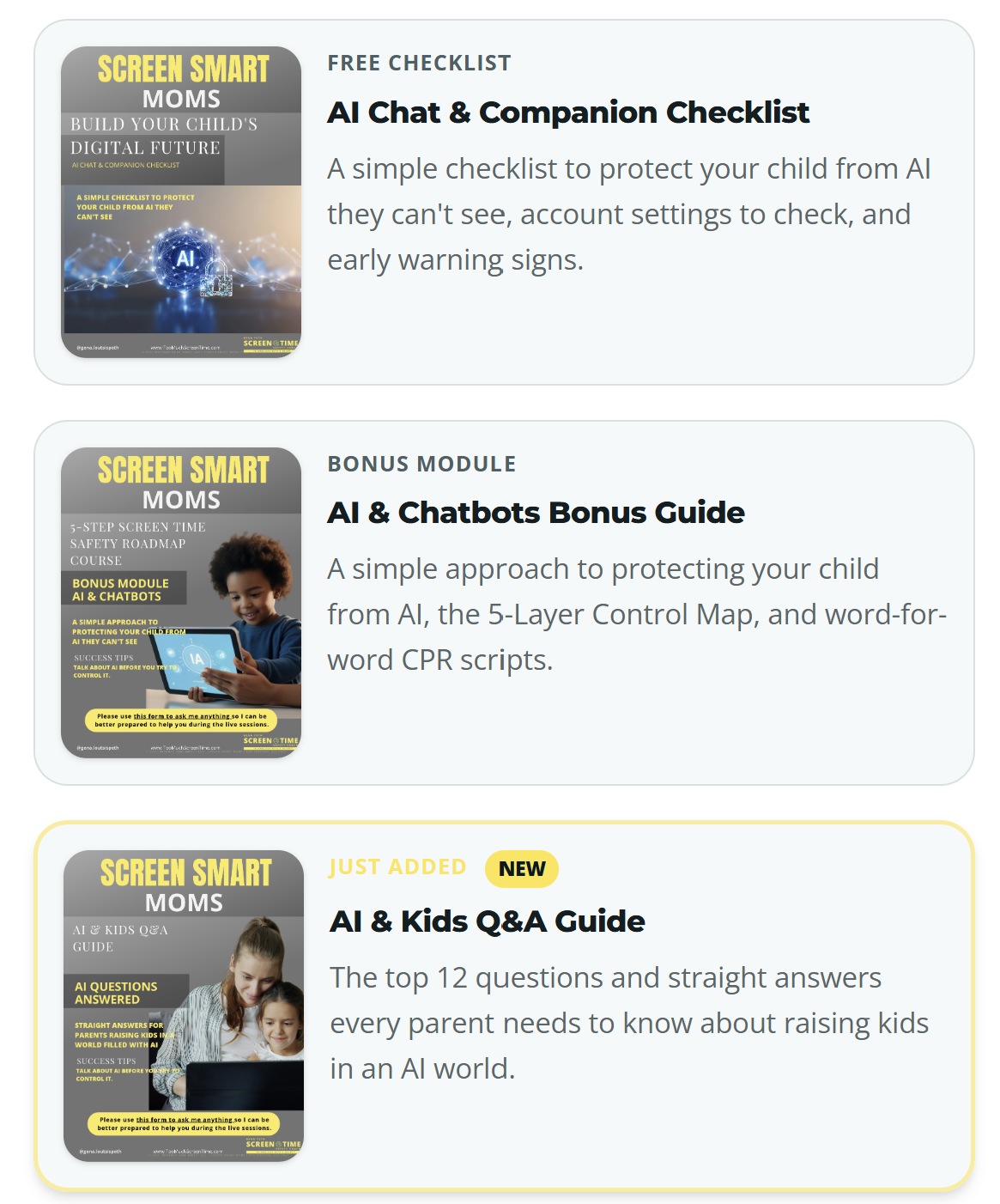
Want straight answers on AI and your kids? Take my short survey, and I'll send you my AI guides: the AI Chat & Companion Checklist, the AI Chatbot Bonus Guide, and the AI & Kids Q&A Guide. They cover what to allow at each age, where to check settings in each app, what to say to your child, and what to do if you find something concerning.
Take the survey and get the guides
Need help today? Schedule a call and follow me on Facebook.
This post is for general education only and is not medical, mental health, or legal advice. Technology and laws change quickly, so check current information.
Join our live webinar with Gena Peth, Screen Smart Moms, to learn what really keeps kids safe online.
Reserve your spot today before it fills up!
Need Help today?
Learn to protect your kids online with confidence. Schedule a call and follow me on Facebook today.
This post is for general education only and is not medical, mental health, or legal advice. Technology and laws change quickly, so check current information.
Comment below and share this post, let’s spark a conversation about protecting kids from endless late-night scrolling!
References and further reading
CBN News, "Parents Should Warn Kids About Robot 'Stranger Danger' After Chatbot Suicide Coaching" (Lorie Johnson, Nov. 10, 2026).
Common Sense Media, "Talk, Trust, and Trade-Offs" (July 2025), national survey of U.S. teens.
OpenAI Help Center, ChatGPT parental controls.
Senate Commerce Committee action on the CHATBOT Act (S. 4407) and Youth AI Privacy Act (S. 4199), August 2026.
California SB 243 and New York's AI companion law.